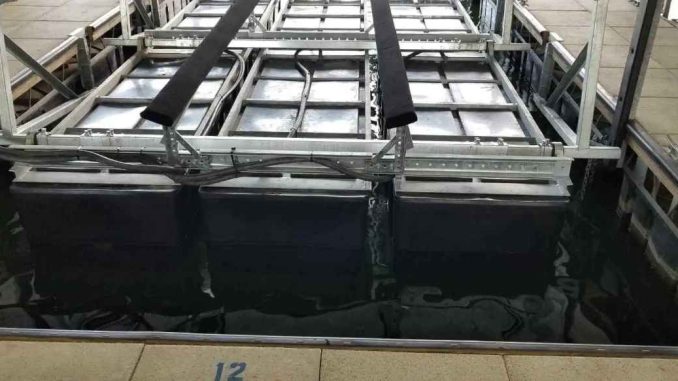
If your dock sits on an open stretch or a high-traffic channel at Lake of the Ozarks, you already know the difference between a calm day and a Saturday afternoon. Wake from large cruisers and pontoons, combined with wind fetch, can turn a normally quiet slip into a constant surge zone. In those conditions, the wrong lift doesn’t just sit there—it transfers energy into the hull, the frame, and the dock connections.
Floating lifts are the usual recommendation for these spots, and for good reason. They rise and fall with the water and can absorb some of the wave energy that a fixed or piling-mounted system fights against. The basics of why boat lifts for rough water outperform fixed systems are well established, but not every floating lift is built the same. The differences matter when the water is rough.
Features that Separate a Rough-water Lift from a Basic One
A few practical details tend to show up on lifts that hold up better in high-wake areas:
- Enough vertical travel. Peak waves on busy days can easily exceed the clearance of a shorter-travel lift. Systems with 60 inches or more of travel give the hull more room to stay clear when the water is moving.
- Wide, stable tank footprint. A broader base resists tipping and reduces side-to-side motion, which is especially useful with wide-beam boats such as pontoons.
- Steel kept above the waterline. Poly tank designs that keep the structural steel out of the water eliminate the constant corrosion cycle that comes from turbulent, oxygenated water hitting metal.
- Proper anchoring and dock connections. Rough water puts extra load on anchors and brackets. Wider scope ratios and reinforced connections are common on installs that last.
These points are covered in more detail in LOTO Lift’s breakdown of what actually works for rough-water docks at the lake: Best Boat Lift for Rough Water at Lake of the Ozarks.
Why the Wrong Type Shows Problems Quickly
Fixed lifts and many standard hydraulic systems are designed to resist movement. In calm water that works fine. In surge, the resistance turns into repeated stress on brackets, frames, and the hull itself. Over a season you can see hull rub, bent components, or accelerated corrosion where metal stays in the water. Floating pneumatic systems that move with the wave instead of fighting it generally transfer less of that energy.
Site conditions still matter. Depth, substrate, prevailing wave direction, and how the dock is built all affect which configuration holds up. This is why custom boat lift installations that account for Midwest lake variables tend to outperform one-size-fits-all systems. A lift that performs well in a protected cove can struggle on an exposed point even if the capacity numbers look the same.
Practical next step
If your dock regularly sees heavy wake, start with a site assessment that looks at wave height, water-level range, and dock structure rather than just boat weight. From there, comparing purpose-built floating options (including models designed around Lake of the Ozarks conditions) against generic systems usually clarifies the trade-offs in maintenance and longevity.
For local options, resources on boat lift sales near me can help narrow the field to providers familiar with lake conditions. The LOTO Lift resource linked above also walks through the key comparisons, anchoring considerations, and what owners typically budget for a rough-water install.

Custom Boat Lift Installations Missouri: Why Precision Matters on Midwest Lakes
Boat owners across Missouri face a unique combination of fluctuating water levels, rocky shorelines, and seasonal weather extremes. These conditions make custom boat lift installations Missouri a

Why Every Boater Needs a Dock Walkway Upgrade
If you’ve ever climbed into your boat from a narrow, wobbly dock edge, you know how sketchy it can feel—especially when the wind picks up

Boat Lifts for Rough Water: Why Floating Lifts Rule the Lake
If you boat in a high-traffic area or unpredictable lake, you know that wakes and waves can do serious damage to a docked vessel. That’s

The Ultimate in Jet Ski Docking Platforms: The Best Floating Dock for Your PWC
If you own a jet ski, having the right jet ski docking platform is essential for protecting your watercraft and enhancing your waterfront experience. With

Preparing Your Jet Ski Dock for Winter: Tips for Lake of the Ozarks Boaters
Winter at Lake of the Ozarks brings a unique set of challenges for boaters and jet ski owners. While many focus on winterizing their PWCs,

Boat Lift Sales Near Me: Protecting Your Boat at Lake of the Ozarks
For Lake of the Ozarks boaters, finding the right boat lift is a top priority. With heavy boat traffic and constantly changing water levels, the

Leave a Reply